Motorized shades: the complete guide for Texas homes
How to choose between battery and wired shades, which fabric openness to pick, how much heat shades really block on west-facing glass, and what to budget per window.
Why motorized shades are worth considering in Texas
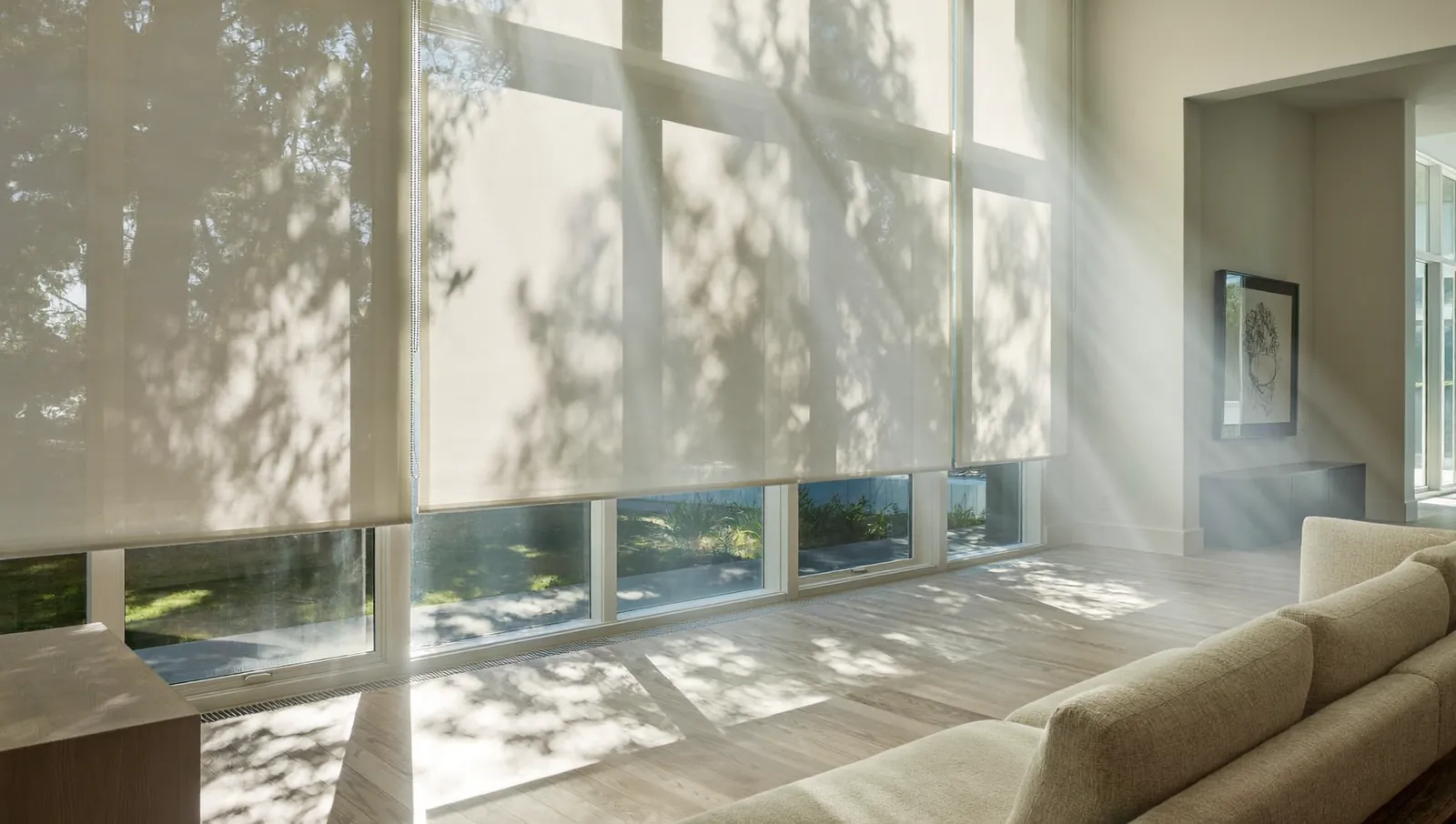
ACEEE calls windows often the weakest link in a building’s thermal envelope. In a North Texas summer, the problem is solar gain: sunlight passes through the glass and turns into heat inside. West-facing glass is the worst offender because it takes the low, direct afternoon sun at the hottest part of the day, when overhangs and eaves do little.
Shades only help if they are down at the right time. That is the real case for motorization. A shade that lowers itself on the west side at 2 p.m. in July, whether you are home or not, does more than a beautiful manual shade that stays up.
Motorized shades also solve practical problems: tall windows nobody can reach, stairwell glass, two-story great rooms, and media rooms that need a clean blackout at the press of a button.
How much heat do shades actually block?
The best public numbers come from the Department of Energy and its national laboratories. They measure different things, so read each number for what it is.
PNNL’s Building America Solution Center guide on window attachments summarizes a simulation study (Rempel et al., 2022) of how shading would have changed indoor conditions in homes without air conditioning during the 2021 Pacific Northwest heat wave. The measure is the number of hours the indoor heat index sat in the “danger” or “extreme danger” range.
Simulation of non-air-conditioned homes in the 2021 Pacific Northwest heat wave, as summarized by PNNL
Approximate reductions from one simulation study; useful for ranking exterior against interior shading, not for predicting your bill.
View the data
| Reduction in danger or extreme danger heat index hours | |
|---|---|
| Exterior shades | 55% |
| Insulating interior shades | 23% |
| Interior roller shades | 18% |
Three lessons hold across the research.
Exterior beats interior. PNNL’s guide notes that exterior attachments block the sun before it reaches the glass, so they are typically more effective at cutting solar heat gain than interior shades. Once sunlight passes through the glass, some of that heat is already inside the room. Even insect screens show the pattern: the same guide cites a 1999 study (Brunger et al.) in which exterior screens cut solar heat gain by 46% and interior screens by 14%.
Vertical shading matters on east and west. The same PNNL guide says that in hotter climates, highly effective shading of east- and west-facing surfaces is of primary importance, and that vertical attachments are very useful on those windows, which roof eaves struggle to shade.
Fit and use matter as much as product. Gaps at the sides let hot air circulate around a shade. A shade that is up during the afternoon saves nothing.
Whole-home energy savings
Heat-gain percentages are not the same as bill savings. For whole-home results, look at field tests.
Pacific Northwest National Laboratory lab homes, as summarized by ACEEE
Bars show the range of measured savings across test configurations; exterior storm windows had a single result.
View the data
| Low | High | |
|---|---|---|
| Cellular shades | 4% | 16.5% |
| Exterior storm windows | 8% | 8% |
| Interior storm windows | 3.5% | 5% |
Other findings worth knowing:
- An October 2021 DOE fact sheet (DOE/EE-2519) says installing window attachments can save 15% of a household’s annual HVAC energy compared with vinyl blinds, citing PNNL lab-home testing.
- Oak Ridge National Laboratory tests summarized in that fact sheet found cellular shades saved up to 20% on heating energy and up to 15% on total heating and cooling energy, compared with no shades. Those experiments focused on the heating season; DOE notes more research is needed on cooling-season benefits.
- PNNL’s Building America guide cites DOE field studies reporting whole-home summertime cooling savings of 15% to 25% from optimized use of high-efficiency shades.
- According to ACEEE’s summary of LBNL modeling, in cooling climates solar screens, window films, roller shades and cellular shades have the greatest savings potential.
- Expect smaller gains if your windows already have a good low-E coating, since the glass is already blocking part of the solar heat.
“Optimized use” is the important phrase. Automation is how you get it without thinking about it.
AERC ratings: how to compare shades on energy
The Attachments Energy Rating Council (AERC) runs a rating, labeling and certification program for window attachments. ACEEE describes it as a membership organization that brings together manufacturers, utilities and public-interest groups. According to ACEEE, AERC’s Energy Performance metric was developed by Lawrence Berkeley National Laboratory and compares the heating or cooling energy savings from adding the attachment with the energy use of the same baseline window without it.
The AERC Energy Improvement label shows two headline numbers:
- Cool Climate Rating, for heating-dominated climates.
- Warm Climate Rating, for cooling-dominated climates. This is the one to weigh in Dallas-Fort Worth.
ACEEE notes that any attachment with a rating above zero improves the energy performance of a window that had no attachment. Higher is better. You can search certified products on AERC’s site and compare them within the same climate rating. Not every motorized product carries an AERC rating, so ask your dealer which fabrics and constructions do.
Choosing fabric: openness factor in plain terms
For roller and solar shades, the key fabric number is the openness factor: the share of the fabric that is open weave, expressed as a percentage. Lutron’s fabric reference guide says higher openness preserves more of the view, while a lower openness factor gives the best heat reflection.
A rough way to think about it (confirm with the actual fabric data):
- Low openness (around 1% to 3%): more glare and heat control, a softer view out. A sensible starting point for west glass, media rooms and TVs that face windows. Lutron also suggests 1% fabrics where acoustics matter.
- Middle openness (around 5%): a balance of view and control for many living spaces.
- Higher openness (10% and up): the clearest view, but more glare and heat. Better for north light or shaded windows.
Color matters as much as openness. Lutron recommends dark-colored screen fabrics for the clearest view-through, and notes that metallic-backed or white-backed fabrics reflect more sunlight out of the space. Draper explains the spec sheet values to compare: solar transmittance (Ts), where higher means more solar energy gets in; solar reflectance (Rs), where higher means more heat is reflected; and visible transmittance (Tv). Compare those numbers, not just the swatch.
Blackout fabrics are fully opaque and belong in bedrooms and theaters. They still leave light gaps at the edges unless you add side channels or a pocket.
Dual shades, a solar shade and a blackout shade on one window, are common in primary bedrooms. Each needs its own motor or a dual-roller assembly, so they cost more.
Battery vs wired power
This is the decision that most affects cost, maintenance and whether your walls need to be opened.
Battery-powered shades
Battery shades use a battery pack or tube inside the headrail or roller. No wiring is needed.
- Best for: retrofits, finished walls, a few windows at a time.
- Battery life claims: Lutron’s Serena IR installation guide states a typical battery life of 3 years, based on two up and two down movements a day on a 3-foot-wide by 5-foot-tall shade with light-filtering fabric, and says it can vary from 2 to 5 years depending on shade size and fabric. Lutron recommends alkaline batteries. Hunter Douglas states that battery life for PowerView shades is about 1 year, depending on shade size, configuration and usage. These are manufacturer claims under their own assumptions, so compare them with care.
- Trade-offs: you will change or recharge batteries. Big, heavy shades and shades that move often drain faster. A 20-foot-high window needs a plan for battery access.
Low-voltage wired shades
Many high-end systems use low-voltage motors powered from a central supply or local power supplies, with control wiring alongside. Lutron’s HomeWorks system architecture drawing, for example, shows Sivoia QS shades wired to low-voltage power panels.
- Best for: new construction, remodels with open walls, large or many shades.
- Pros: no batteries, consistent speed and sync across a wall of glass, quiet operation.
- Licensing: TDLR exempts work on Class 1, 2 or 3 remote-control, signaling or power-limited circuits from state electrician licensing. The 120-volt circuit that feeds the power supply is still electrical work for a TDLR-licensed electrician.
Line-voltage shades
Some motors run directly on 120 volts, with a junction box or plug near each shade.
- Best for: very large or heavy shades and exterior screens, where torque matters.
- Licensing: this is line-voltage electrical work. TDLR says anyone performing non-exempt electrical work in Texas must be licensed and work through a licensed electrical contractor. Local permits may apply.
Which to choose
| Situation | Usual best fit |
|---|---|
| Finished home, a few rooms | Battery |
| New build or full remodel | Low-voltage wired, pre-wire every window |
| Tall or hard-to-reach glass | Wired (no battery changes on a ladder) |
| Large exterior screens | Line-voltage or heavy-duty low-voltage |
| Rental or short horizon | Battery |
If you are building, pre-wire every window that might ever get a shade. Cable to a window head costs little during framing and a lot later.
Pockets, fascia and the finished look
How the shade is housed matters as much as the fabric.
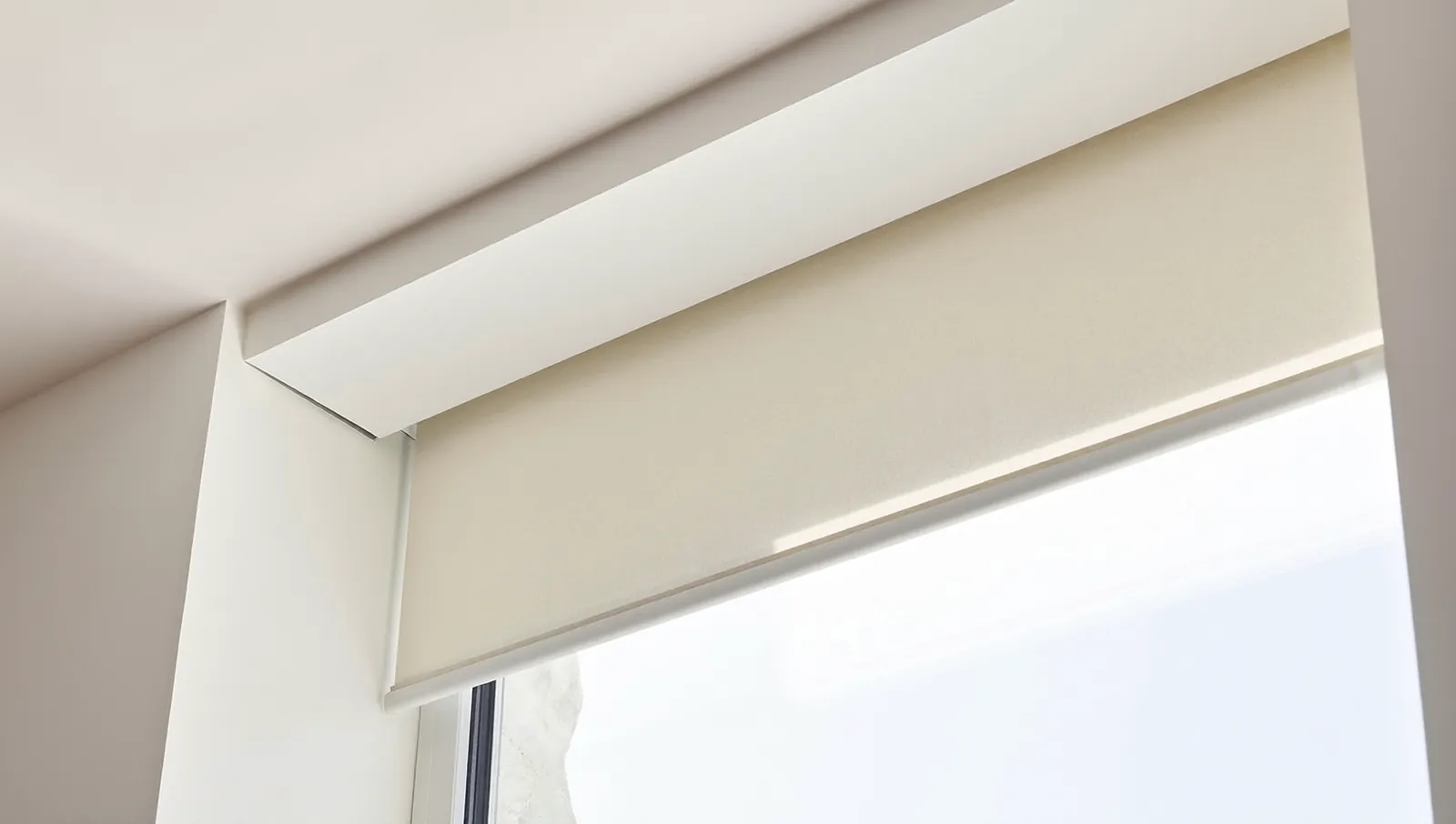
- Ceiling pocket (recessed): a channel built into the ceiling or soffit above the window. The rolled shade disappears when raised. This is the cleanest look and must be planned before drywall. Size the pocket for the rolled-up fabric diameter plus motor, which grows with drop length and fabric thickness; get dimensions from the shade manufacturer.
- Fascia: a metal or fabric-wrapped cover that hides the roller. Good for retrofits and inside-mount windows without a pocket.
- Cassette or headbox: a closed housing, often with matching side channels for light control.
- Inside mount vs outside mount: inside mount looks tidy but leaves light gaps at the sides. Outside mount covers more of the frame and blocks more light and heat.
- Side channels: tracks that close the edge gaps. Worth it for bedrooms and theaters.
Coordinate early with your builder and architect on window head height, pocket depth, HVAC supply registers near windows (air blowing on a shade makes it sway) and where power or wire will land.
What motorized shades cost
Cost per window is the most common question and has the widest answers. National cost guides publish these ranges for professionally installed motorized window treatments:
National ranges from cost-guide publishers, 2024 to 2026
National ranges per window installed; window size, fabric, power type, pockets and control system move the price more than anything else.
View the data
| Low | High | |
|---|---|---|
| Motorized blinds, typical range (Angi) | $400 | $2,500 |
| Motorized roller blinds (Angi) | $400 | $900 |
| Motorized zebra blinds (Angi) | $800 | $1,500 |
| Electric blinds (HomeAdvisor) | $300 | $1,000 |
| Motorized blinds (HomeGuide) | $300 | $1,000 |
Angi puts the 2026 national average at about $500 per window, with most homeowners spending $400 to $2,500. HomeAdvisor lists an average of about $650 per window, within a $300 to $1,000 range, and says roughly half of that is the motor. HomeGuide’s September 2024 guide gives $300 to $1,000 per window installed. These are national figures from cost-guide publishers, not Dallas-Fort Worth quotes.
What pushes the price up:
- Size. Tall and wide windows need bigger tubes, stronger motors and more fabric.
- Fabric. Designer and high-performance fabrics cost more than basic screens.
- Power. Wired systems add electrical and low-voltage labor but remove battery upkeep.
- Dual shades and side channels.
- Pockets and fascia. Built-in pockets add carpentry and drywall work.
- Control system. Shades tied into a whole-home lighting or automation system add programming and keypads.
- Exterior shades and screens. These need weather-rated hardware and often line-voltage power.
For context, ACEEE’s 2019 brief put the median price of most residential interior window attachment types at around $100, which shows how much of a motorized shade’s cost is the motor, controls and installation.
Automation that actually saves energy
Motorization pays off when the shades move on their own. Useful automations:
- Sun-tracking schedules. Lower west-side shades in the afternoon and east-side shades in the morning, based on sunrise and sunset times for your location.
- Seasonal settings. In summer, keep sun-facing shades down during peak heat. In winter, PNNL’s guide advises opening attachments when sun is shining on the window to allow solar heat gain, and closing them at night and on cloudy days to limit heat loss.
- Away mode. When the house is empty, keep sun-facing shades down.
- Room scenes. One keypad button that sets lights and shades together for movie night or bedtime.
- Privacy at dusk. Street-facing shades close automatically at sunset.
Avoid automations that fight people. A shade that drops on someone reading by the window gets disabled. Give each room a manual override and keep automations simple.
Mistakes to avoid
- Choosing fabric from a small swatch indoors. Look at a full-size sample on the actual window in afternoon sun.
- Skipping pre-wire in new construction and then paying for batteries forever.
- No access plan for batteries on tall windows.
- HVAC registers blowing straight up into a shade.
- Expecting interior shades alone to fix a hot west room. Exterior screens or awnings may be the bigger lever.
- Hiring an unlicensed installer to add 120-volt outlets or motor circuits.
Questions to ask a shade installer
- Which fabrics in my selection have an AERC rating, and what is the Warm Climate Rating?
- What is the openness factor and solar transmittance of each fabric you are proposing?
- Battery, low-voltage or line-voltage, and why for each window?
- What battery life does the manufacturer state for these shade sizes, and how are batteries changed?
- Who is the TDLR-licensed electrician for any line-voltage work?
- How will the shades integrate with my lighting control or smart home system?
- What pocket or fascia dimensions do you need from my builder, and by when?
What to do next
Start with the hottest, brightest rooms. Stand in each room at 4 p.m. on a sunny day and note which windows cause heat and glare. Those windows, usually west and southwest, are where motorized shades and possibly exterior screens deliver the most comfort.
If you are building or remodeling, ask your builder to pre-wire every window head and to frame pockets where you want a clean look. Decide on fabric openness with full-size samples in place.
If you are in Dallas-Fort Worth, we are happy to look at your plans and help you sort out which windows matter most.
Frequently asked questions
Do motorized shades really lower energy bills?
They can. PNNL field tests summarized by ACEEE found cellular shades saved 4% to 16.5% of cooling-season energy, and DOE field studies cited by PNNL report 15% to 25% summer cooling savings from optimized use of high-efficiency shades. Results depend on your glass, orientation and whether the shades are actually down when the sun is on the window, which is what automation provides.
How long do motorized shade batteries last?
It depends on the brand, shade size and how often it moves. Lutron states a typical 3 years (2 to 5) for Serena under two up and two down moves a day, and Hunter Douglas states about 1 year for PowerView. Large, heavy shades and frequent moves shorten battery life.
What openness factor is best for west-facing windows?
Lower openness, often 1% to 3%, gives more control over heat and glare on west glass. Compare solar transmittance and reflectance values on the fabric spec sheet, and look at a full-size sample in afternoon sun before deciding.
Are exterior shades better than interior shades?
For heat, generally yes. Exterior shades stop sunlight before it reaches the glass, which PNNL notes is typically more effective than interior shading. They cost more and need weather-rated hardware.
Do I need an electrician for motorized shades in Texas?
Battery shades need no electrical work. Low-voltage control and power-limited wiring is exempt from state electrician licensing, according to TDLR, but any 120-volt circuit, outlet or line-voltage motor connection is electrical work that requires a TDLR-licensed electrician.
Sources
- Interior Cellular Shades Boost Home Energy Performance (DOE/EE-2519), U.S. Department of Energy, October 2021
- Residential Window Attachments, Emerging Opportunities Series, ACEEE, 2019
- Window Attachments for Solar Control and Energy Efficiency, Building America Solution Center, Pacific Northwest National Laboratory, updated 2023
- Attachments Energy Rating Council, product ratings and label
- Getting it right: using performance measurements to choose the right shade fabric, Draper, 2020
- Quick Fabric Reference Guide, Lutron Electronics, Summer 2026
- Serena IR Remote Controlled Shades installation guide, Lutron Electronics
- How long can I expect the batteries to last on my battery-powered motorized window covering?, Hunter Douglas
- HomeWorks System Architecture for 120 VAC and 434 MHz regions, Lutron Electronics
- How Much Do Motorized Blinds Cost? [2026 Data], Angi, updated October 2026
- How Much Do Electric Blinds Cost?, HomeAdvisor, updated June 2026
- How Much Do Motorized Blinds Cost?, HomeGuide, September 2024
- Exemptions to Electrician Licensing, Texas Department of Licensing and Regulation
- Electricians, Texas Department of Licensing and Regulation
More from the Journal
Tunable white and circadian lighting: what the research actually shows
Light at the eye affects your body clock, and the science now gives real numbers. Here is what is proven, what is not, and how a lighting control system puts the numbers to work at home.
Control4 vs Savant vs Crestron: which smart home system fits your home?
How the three big professional platforms compare on interfaces, dealers, programming, yearly fees and long-term support, plus where Josh.ai, Lutron-only systems and DIY options like Home Assistant and Apple Home fit.
Is home automation worth it, and does it add resale value?
What buyer surveys, listing studies and federal energy data actually show about smart home value, where the evidence is strong, where it is thin, and how to spend so the money holds up.
Planning a project in Dallas–Fort Worth?
Tell us about the house. You get a clear scope and a price range back.